
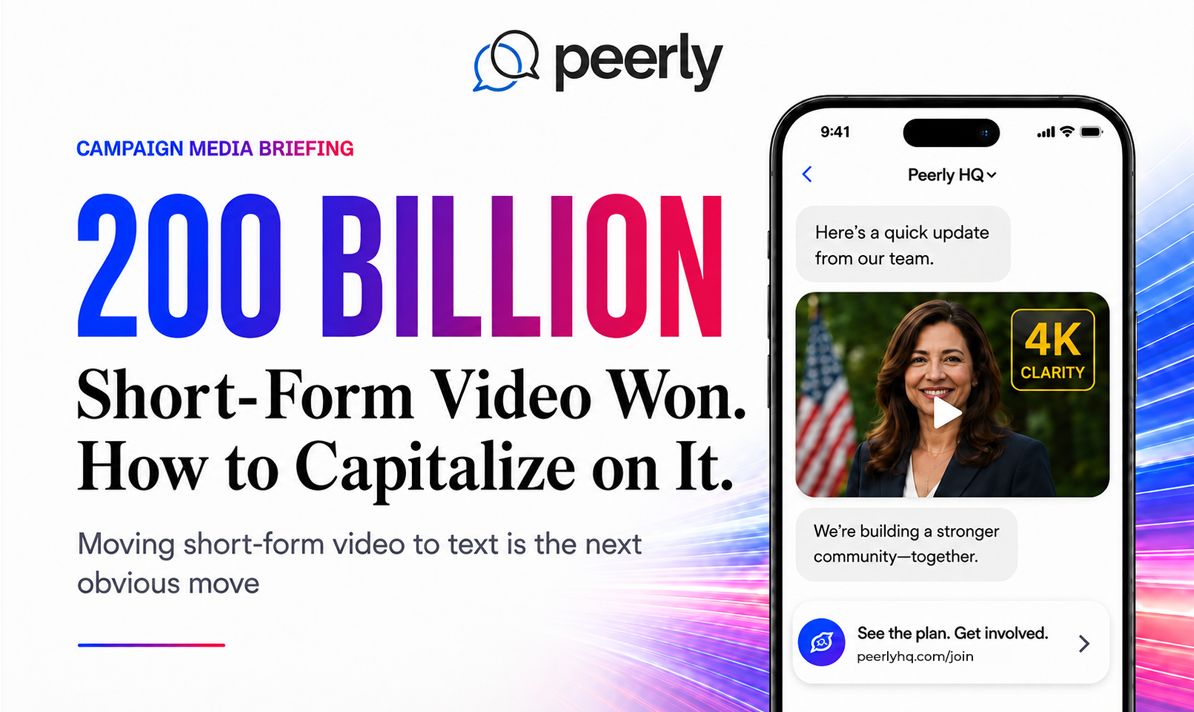
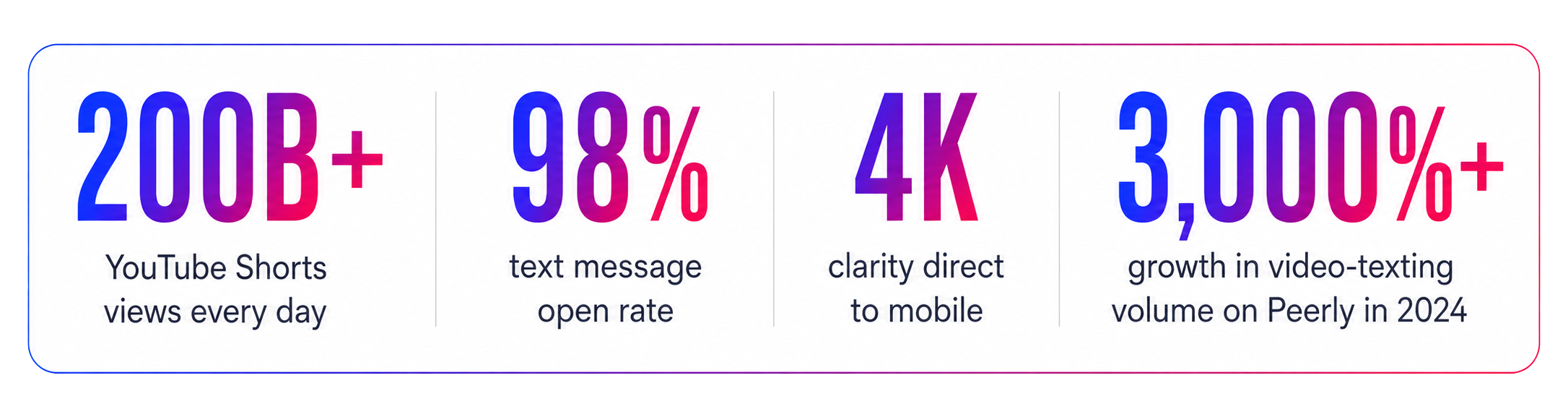
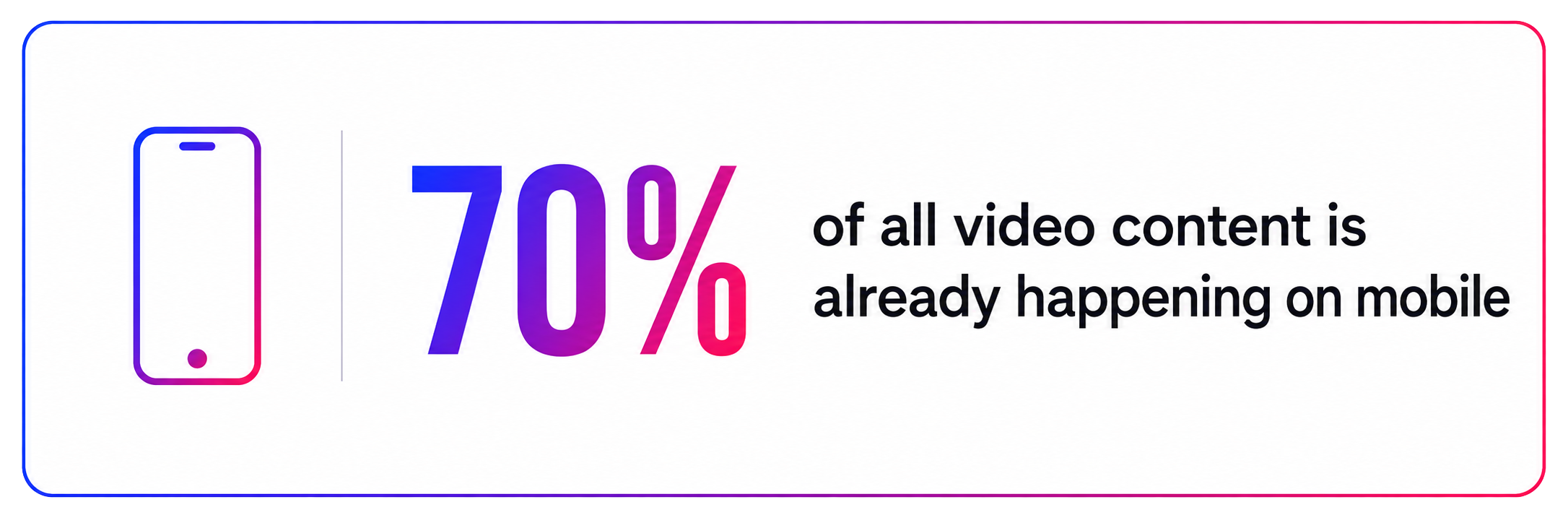
YouTube Shorts now averages more than 200 billion views every day. The Ericsson Mobility Report says video makes up about 75 percent of all mobile data traffic. HubSpot’s 2026 marketing research ranks short-form video as the most widely used media format and the format marketers most often credit with the highest return. (blog.youtube)
The most powerful video format in the world was built for the phone. Campaigns are now learning what happens when it reaches voters without the feed, the algorithm or the competition.
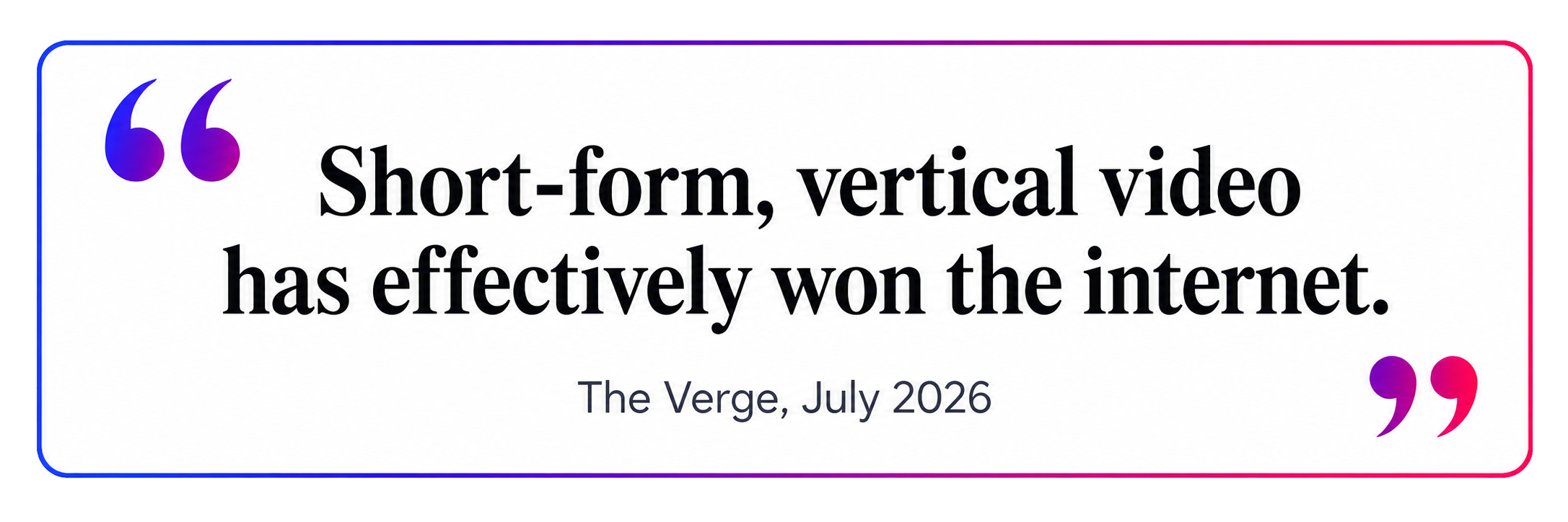
“Short-form video has effectively won the internet.”
The Verge, July 2026 (The Verge)
The numbers are hard to ignore.
Video won. Short-form video won. And the phone became its natural screen.
The next shift is only now becoming clear inside campaign war rooms.
Campaigns have spent years learning how to make short-form videos for the phone. Yet they still usually deliver those short-form videos through a crowded social feed, where the voter is already watching another video.
The campaign ad interrupts the content the voter chose. It competes with creators, news clips, sports highlights, comments, alerts and the next swipe.
That is the irony of modern political advertising.
Campaigns are using video to interrupt video.
What happens if they keep everything that makes short-form video powerful, but remove the feed around it?
Behind the scenes, campaigns have already begun doing exactly that.
Peerly’s platform data shows video-texting volume rising from roughly 10 million messages per year in earlier cycles to a few hundred million during the 2024 election cycle. That is growth of more than 3,000 percent. (Peerly)
Donald Trump and Nikki Haley were visible examples, but this was never a two-campaign story. According to Peerly’s internal campaign history, the technology has been used across presidential campaigns, governors and gubernatorial races, dozens of U.S. Senate campaigns, congressional races and major political organizations.
Today, tens of millions of these commercials continue to be delivered. What started as an experiment is becoming a real line in campaign media budgets.
Now the technology has made another major leap: 4K clarity.
Short-Form Video Was Built for the Phone
TikTok, YouTube Shorts and Instagram Reels did not make short-form video popular by accident.
The modern short-form video format fits the phone. It is quick, visual and easy to watch while moving through the day. It can work with the sound off. It fills the screen. It asks for only a small amount of time.
The format is not the problem.
The delivery setting is.
Deloitte describes social video platforms as offering an almost endless stream of free content that is “algorithmically optimized for engagement and advertising.” (Deloitte)
That makes social media powerful. It also makes it one of the most competitive places on earth for attention.
The voter did not open TikTok, YouTube or Instagram to watch the campaign’s ad. The voter opened the app to watch something else. The campaign pays to step between the viewer and the content the viewer selected.
A 2025 consumer survey covered by eMarketer found that 55 percent of respondents skip ads when they can, while another 37 percent ignore them regardless of the platform. (Clutch)
That does not mean social media has no value. Social video can create reach, repetition and public conversation.
It means campaigns should stop confusing the power of short-form video with the power of the social feed.
The short-form video is the valuable part. The feed is rented distribution.
What Changes When the Feed Disappears?
Now place the same video in a different setting.
Instead of putting the commercial between two other videos, the campaign delivers it directly into a selected voter’s text thread.
The message arrives on the voter’s own phone. When it is opened, the commercial is not sharing the screen with another creator, another advertiser or a competing political message. An algorithm does not decide whether it appears in the feed.
The campaign chooses the audience, the creative, the timing and the next action.
This is the idea behind direct-to-mobile video and Peerly’s Video in Motion technology.
The commercial is no longer an ad wrapped around someone else’s content.
It is the content.
The message can be written for a specific voter group. It can mention a local issue, a county, a voting deadline or another point that gives the video meaning. It can include up to 2,000 characters of text, clickable links and a direct invitation to reply. (Peerly)
That changes what one commercial can do.
The video can create emotion. The text can provide context. The link can show proof or ask for action. The reply path can begin a real conversation.
The Text Inbox Has an Attention Advantage
Pew Research Center reports that 98 percent of American adults own a cellphone and 91 percent own a smartphone. (Pew Research Center)
CTIA, the U.S. wireless industry association, cites a 98 percent open rate for text messages. (CTIA)
An open is not the same as a completed video view, and it should not be presented that way. But it clears the first hurdle every campaign message faces.
The voter noticed the message in a channel people regularly check.
The campaign is not hoping that voter happens to be watching the right cable program, using the right streaming service or scrolling the right feed at the right moment.
The message reaches the device tied to the voter record the campaign selected.
That is a very different starting point from an impression inside a crowded feed.
4K Clarity is a Giant Leap Forward
For years, video over text came with a serious compromise.
Campaigns could spend thousands of dollars producing a polished commercial, then watch it become grainy, choppy and heavily compressed when it was sent by MMS. The lighting, color, sound and motion that made the spot effective were often lost.
That barrier has changed.
Campaigns can now take the 4K or HD creative they already own and deliver it directly inside the messaging app in 4K clarity. Longer commercials can also be delivered in full 1080p HD for up to 60 seconds. (Peerly)
This is not a small upgrade.
It means the mobile version can preserve the quality of the original creative. The candidate looks clear. Text stays sharp. Motion remains smooth. Color and sound carry the impact the production team intended.
Artificial intelligence helps prepare the video for the way people actually watch on a phone.
AI can select the strongest frame for the thumbnail or create a custom thumbnail. It can produce closed captions for silent viewing. Motion optimization can reduce blur and improve clarity while the voter is on the move. (Peerly)
The thumbnail acts like a headline. The captions make sure the message still works at work, in a waiting room, in a checkout line or anywhere else the voter cannot turn on the sound.
The result is not a television commercial squeezed into a text message.
It is high-quality video prepared for the mobile screen.
One Message Can Do More Than One Job
A social media video is usually a brief, isolated impression. It appears, then the feed moves on.
A direct-to-mobile message can carry the video and the full case around it.
A campaign can explain why the issue matters. It can include a quotation, a local fact, a policy comparison or a source link. It can ask the voter to donate, RSVP, volunteer, request a ballot or watch a longer piece of content.
Most importantly, the voter can answer.
When direct video is combined with Canvasser AI, incoming replies can be sorted by intent and tone. The system can identify support, opposition, questions, donor interest and volunteer interest. It can record useful data and help prepare a campaign-approved response. (Peerly)
The campaign is no longer limited to showing a message.
It can learn from the response and decide what should happen next.
That is the difference between advertising at a voter and communicating with one.
The Budget Math Is Hard to Ignore
Reuters reported that political advertising spending in the 2026 U.S. election cycle is projected to reach a record $11.6 billion. (Reuters)
A large share of that money will still go to broadcast television, local cable, connected television, streaming and social media. Those channels can remain useful, but campaigns should understand what they are buying.
Local cable sells a zone, a schedule and an estimated audience.
Streaming and social platforms sell impressions inside systems they control.
Direct-to-mobile video delivers the campaign’s message to a selected voter record.
A cable buy can reach many people outside the campaign’s target universe. A social platform may find the right type of voter, but the campaign still depends on the platform’s audience model, auction and algorithm.
With direct delivery, the campaign starts with its own compliant list.
Under Peerly’s current campaign pricing, 4K-clarity video carries no added video surcharge. It is included at the standard MMS rate.
For that same message, the campaign can deliver the video, add up to 2,000 characters of context, include trackable links and invite a two-way reply.
It is not simply another video impression.
It is a complete voter contact.
We Have Watched a New Medium Take Shape
The strongest proof is not a prediction. It is what campaigns have already done.
Video texting moved from roughly 10 million messages a year to a few hundred million in one election cycle. Major presidential campaigns helped prove the scale. Governors, Senate campaigns, congressional campaigns and political organizations broadened the use cases. (Peerly)
Donald J. Trump for President and Peerly received the 2025 Reed Award for Best Use of SMS on a Campaign from Campaigns & Elections. (Campaigns & Elections)
Campaigns are now using direct-to-mobile video for persuasion, fundraising, rapid response, event promotion, ballot education and turnout.
That is how a new medium takes hold.
It begins as a test. A few campaigns try it. The quality improves. The volume grows. Then it becomes part of the plan.
Television is not disappearing. Social media is not disappearing. Streaming is not disappearing.
The smarter media plan will use each channel for what it does best.
Television can create broad awareness. Social media can build repetition and public discussion. Connected television can add targeted reach.
Direct-to-mobile video provides precision, context and interaction.
A campaign can launch its closing argument on television, then place the same commercial directly into the text threads of the persuadable voters most likely to decide the race.
It can send a county-specific version to one community, a donor version to past contributors and a turnout version to supporters who still need to vote.
The creative does not have to change.
The delivery becomes smarter.
Short-form video already won the battle for the phone.
The next shift is about who controls the delivery.
Will the campaign keep renting a moment inside someone else’s feed?
Or will it deliver the message directly to the voter, in 4K clarity, with context, a call to action and the ability to answer back?
That is not simply better video texting.
It is a new political media channel.
And the shift is already underway.