
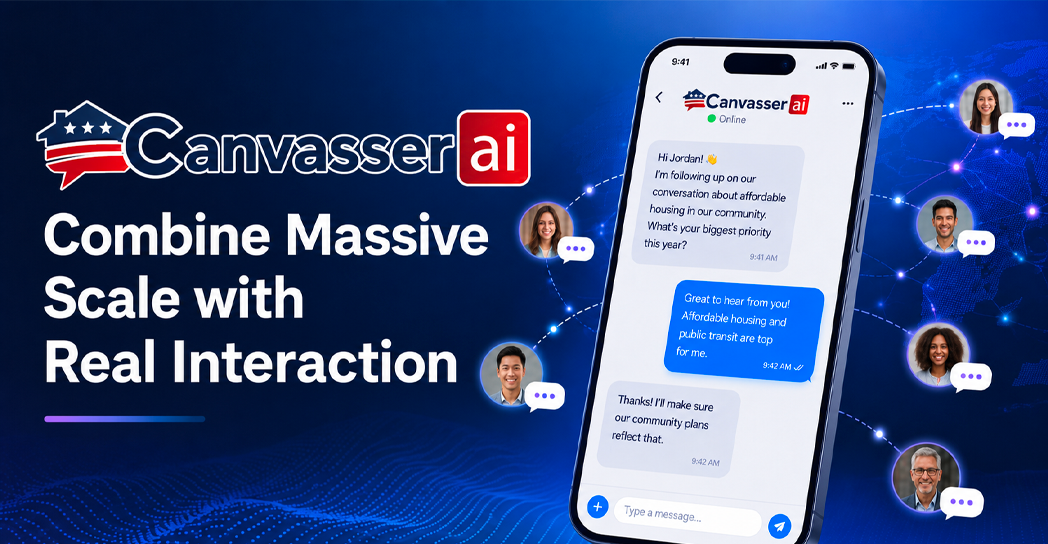
There is no other tool on Earth that allows a campaign to canvass millions of voters simultaneously with real two-way conversations, structured data capture, and campaign-approved messaging at scale the way Canvasser ai does.
That statement matters, because it’s describing something campaigns have never been able to do before: combine massive scale with actual interaction. Broadcast channels can reach millions, but they don’t. Door knocking can canvass, but it doesn’t scale. Until Canvasser ai, campaigns were forced to choose one.
The problem: traditional canvassing doesn’t just cost money, it caps your ceiling
Canvassing is still the most respected form of voter contact because it’s personal. When it works, it works because a human being is listening, responding, and moving the conversation forward.
But the operational reality is ugly.
Even highly organized programs produce surprisingly little “real contact” per hour. Field guides commonly estimate ~15 doors per hour (about one door every four minutes) for canvassers. (Power Coalition for Equity and Justice) Even then, a large share of knocks result in no contact. In classic field experiments, reported contact rates around ~32%–37% are common. (PMC)
That means campaigns burn huge resources just to get to a conversation, and then deal with even more friction once a door opens:
-People are busy, distracted, cooking dinner, dealing with kids, or simply not in the mood.
-Many voters will give a “whatever gets you off my porch” answer rather than a thoughtful one.
-The voter you actually need might be at work and you’re talking to someone else in the household.
-Volunteer quality varies, message discipline varies, and data entry varies.
And the most under-discussed problem: data integrity and follow-up speed. Door conversations are only valuable if the data is captured cleanly and the campaign can act on it fast. But field data is often inconsistent, late, or incomplete and by the time you follow up, the moment is gone.
Yes, door-to-door canvassing can move numbers. One well-known randomized experiment found personal canvassing increased turnout by about ~6 percentage points. (PMC) But the same research ecosystem makes the tradeoff clear: door-to-door works and it’s hard to bring to scale. (policyreview.info)
So, campaigns keep doing it…and keep hitting the same ceiling.
The second problem: modern campaigns need scale and conversation
Campaigns don’t need more “reach”. They need more meaningful contacts and better voter intelligence and they need it faster than the other side.
That’s why texting exploded. In the final three months of the 2020 election, it’s been estimated that Americans received 11.6 billion political messages. (techforcampaigns.org) That’s not a trend, that’s an irreversible shift in where voter attention lives: on the phone.
But texting creates a new bottleneck: reply volume.
If you canvass at scale through P2P texting, replies don’t come in politely spaced out over a Saturday afternoon. They come in all at once.
And reply rates can be very meaningful. One large analysis of political P2P messaging reported average response rates that varied by tone, with figures in the mid-single digits up to ~11%.
Do the math:
If you engage 1,000,000 voters and even a fraction respond, you’re suddenly looking at tens of thousands (or more) inbound replies. That’s not a “staff harder” problem. That’s a physics problem. The campaign either has an intelligence layer that can manage two-way at scale or the canvass collapses into ignored messages, missed persuadables, missed volunteers, missed donors, and missed data.
Reintroducing the solution: What Canvasser ai changes
Canvasser ai is modern canvassing for modern campaigns. It takes the intent of canvassing; persuasion, identification, issue discovery, commitment, follow-up and delivers it through compliant P2P texting with a campaign-controlled intelligence layer.
It’s the first system designed to make this possible:
-Canvass millions simultaneously
-Hold real two-way conversations
-Capture structured data automatically
-Deliver only campaign-approved messaging
-Maintain ethical boundaries at scale
And critically: Canvasser ai is not trying to be “cute AI”.
This is not a chatbot. It’s controlled intelligence
Most “AI” products in politics are either:
- a generic chatbot that improvises language, or
- an auto-responder that creates risk the moment things get complex.
Canvasser ai is neither.
It is a campaign-controlled canvassing engine that operates inside your P2P program using pre-approved messaging, structured templates, and defined conversation paths. Every response aligns with strategy. Every data point is captured with purpose.
This is the key concept: we’re not automating creativity, we’re operationalizing correctness. The intelligence is in classification, routing, enforcement, and structure, not random language generation.
Why the “human-sent” piece matters
Campaigns are right to be sensitive about compliance and ethics. Canvasser ai is designed around that reality.
Powered by AMP AI, every outbound message is still affirmatively sent by a human through compliant peer-to-peer (P2P) software, preserving regulatory adherence while dramatically increasing efficiency.
So, you get the scalability advantage of automation without crossing the line into faceless, uncontrolled messaging. That’s what “ethical communication at scale” actually means in practice: the campaign remains in control, humans remain accountable, and the system is built to scale responsibly.
What Canvasser ai gives you that door knocking can’t
Door knocking is linear. You add people, you add doors. If you don’t add people, you don’t add doors.
Canvasser ai is exponential. You can run voter ID, persuasion, issue discovery, volunteer recruitment, and turnout pushes at the scale of entire cities, counties, and states while keeping the interaction structured and the data usable.
And it solves the biggest hidden failure mode in modern field: the inability to process real voter interaction at volume.
When tens of thousands of voters reply, Canvasser ai ensures those replies don’t become chaos. They become:
-categorized engagement
-structured voter intelligence
-and clean next-step workflows
The simplest way to understand the power
In the time it takes to speak to 20 voters at the door, Canvasser ai can engage and collect data from a million.
That isn’t hype for the sake of hype, it’s the core transformation: canvassing that scales to modern campaign reality.
Door knocking will always exist. But the campaigns that win going forward will be the ones that can do what door knocking can’t:
Talk to millions, listen to thousands, learn instantly, and follow up intelligently without losing control of the message or crossing ethical lines.
That’s what Canvasser ai is.