
Your Ads Are Being Skipped. Here’s the Billion-Dollar Answer.
Three numbers explain one of the biggest shifts in digital campaigning: roughly 75% of mobile data traffic is now video, 93% of consumers say they skip or block ads, and Peerly has recorded more than 3,000% growth in video-texting volume. The creative did not fail. The distribution model did.
By the end of 2025, video had swallowed the mobile internet. Ericsson reported that roughly 75% of mobile data traffic was video, a remarkable concentration of attention around one format. The phone had become a video screen first and almost everything else second. Campaigns, brands and publishers followed the audience. Commercials became shorter, faster, more vertical and more native to the way people actually use a device.
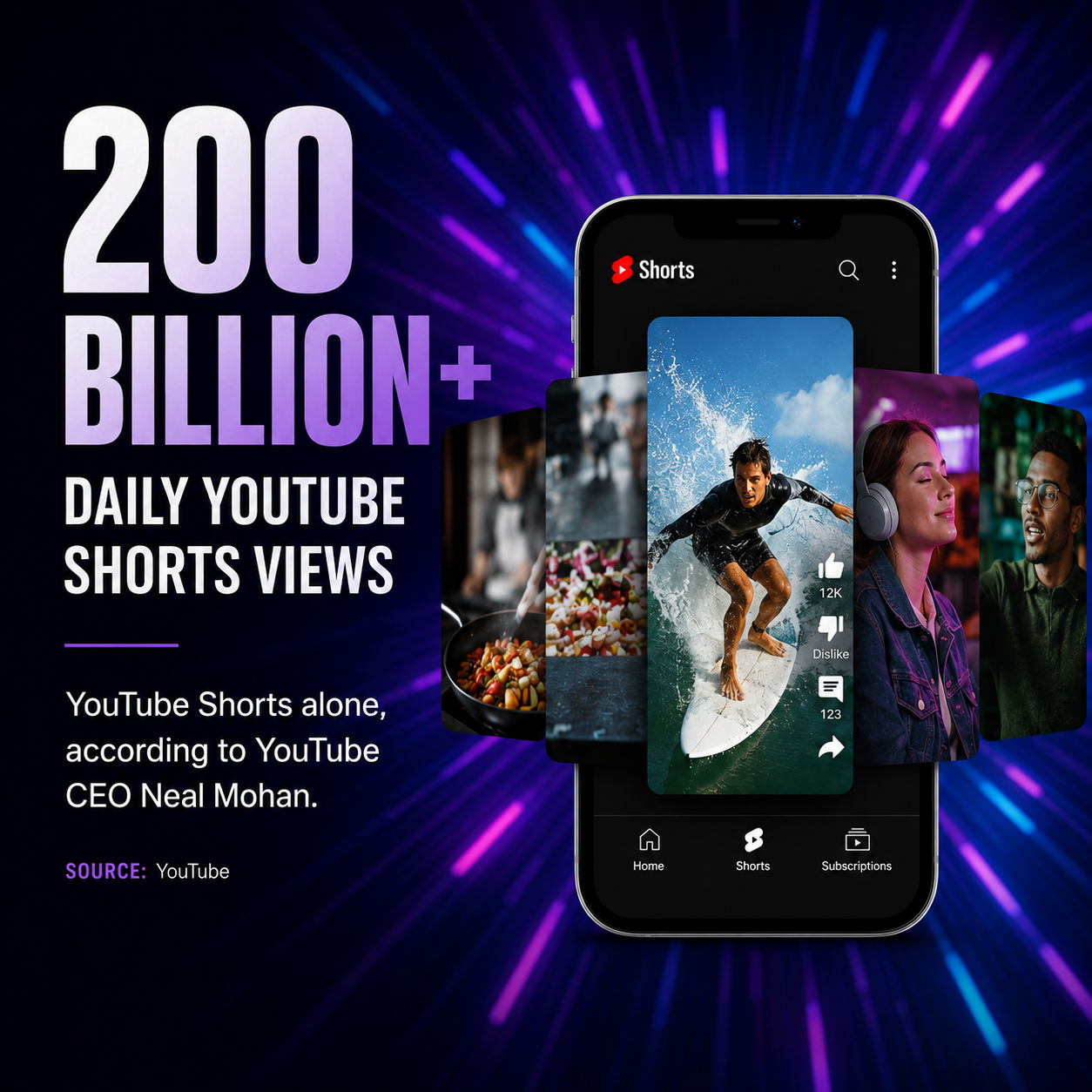
The scale is difficult to overstate. At Cannes Lions in 2025, YouTube CEO Neal Mohan said Shorts had surpassed 200 billion daily views. Short-form video was no longer a niche format or a social-media trend. It had become a default behavior. HubSpot's 2026 marketing data continued to rank short-form video among the most widely used and highest-return formats for marketers. For anyone trying to persuade, mobilize or sell, the conclusion seemed obvious: make more video.
Then the second number changed the story.
Research reported by EMARKETER from a Clutch consumer study found that 93% of consumers skip or block ads. The same mobile environment that made video dominant had also trained people to escape advertising with astonishing efficiency. A viewer can spend an hour watching video and still give a campaign commercial less than a second before swiping past it.
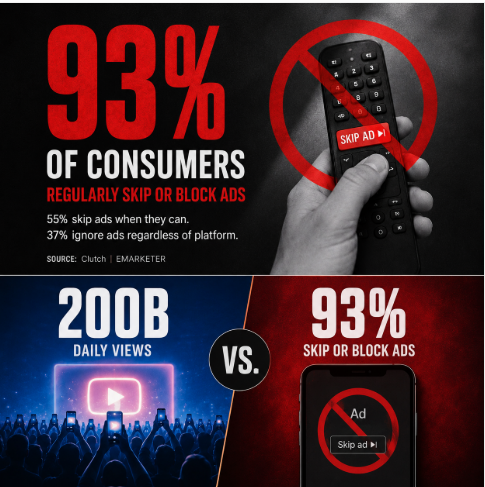
That is the contradiction now sitting at the center of digital advertising: people want video, but they do not necessarily want the advertising wrapped around it. The problem is not that audiences stopped watching. They are watching more than ever. The problem is where the commercial appears, what surrounds it, and how quickly the viewer can replace it with something they actually chose.
The feed solved discovery. It did not solve attention.
The modern feed is an extraordinary machine for keeping people moving. It learns what a user is likely to watch next, then serves an endless sequence of creators, news clips, sports highlights, recipes, friends, outrage, humor and entertainment. Deloitte's Digital Media Trends research describes an environment built around abundant, algorithmically optimized content. That is why social platforms are so effective at discovery. It is also why they are unforgiving places for an interruption.
Consider what a campaign is actually buying. It may spend tens of thousands of dollars producing a polished 30-second spot, carefully testing the message, the imagery and the call to action. Then it places that asset between two pieces of content the voter selected or an algorithm believes the voter will like more. The ad is not simply competing with another advertiser. It is competing with the next swipe.
The distinction between an impression and actual attention is becoming harder to ignore. In a peer-reviewed digital-video study, only about 22% to 24% of Instagram Reels placements were viewed through to completion, while roughly 11% to 22% of skippable YouTube placements reached the end. Under a stricter attentive-view measure, the rates were lower. The study examined public-service advertising, not political campaigns, so it should not be treated as a universal political benchmark. Its importance is the distinction it exposes: delivery, playback, completion and attention are not the same event.
For years, the response to this problem was to optimize the ad for the feed. Make the first two seconds louder. Cut the commercial to fifteen seconds. Add captions. Shoot vertically. Put the candidate's face on screen immediately. Those techniques can improve performance, but they do not change the underlying bargain. The campaign is still renting a brief interruption inside someone else's content stream.
The next shift is not away from video. It is away from the feed.
This is where video texting begins to look less like a messaging feature and more like an emerging media channel. Instead of asking a platform for one more chance to place a commercial between two pieces of content, a campaign can deliver video directly to a selected mobile audience. The format stays familiar. The distribution changes.
That change matters because the phone is already the common screen. Pew Research Center reports that 98% of U.S. adults own a cellphone and 91% own a smartphone. CTIA cites a 98% open rate for text messages. An open rate is not the same thing as a video completion rate, and neither guarantees persuasion, but it explains why messaging has become such an attractive entry point: the channel is routinely noticed.
The strategic difference is simple. In a feed, the platform typically begins with an audience model, an interest category, a look-alike, a program, a geography or an algorithmic prediction. Direct-to-mobile campaigning can begin with the campaign's own compliant voter universe. Persuadable voters can receive persuasion. Identified supporters can receive turnout creative. Past contributors can receive fundraising video. A county can receive a localized version of the same statewide spot. The campaign is not asking an algorithm to find people who resemble the audience it wants. It can begin with the audience it has already chosen to contact.
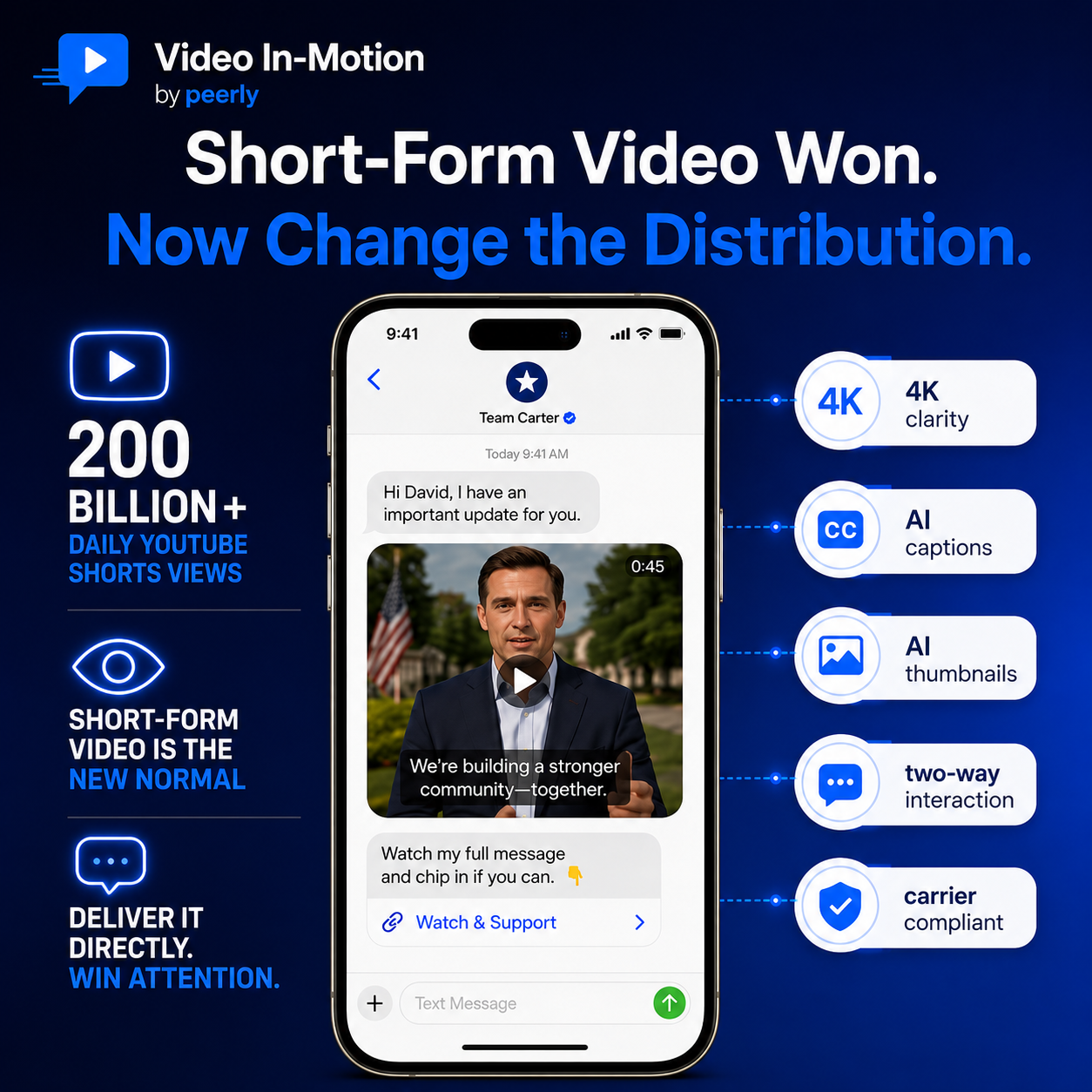
The message can also do more than play. A direct mobile video can arrive with supporting copy, source links, a call to action and a reply path in the same communication. The video supplies the emotion. The text supplies context. The link supplies evidence. The reply can start a conversation. With systems such as Peerly Canvasser AI, inbound responses can be organized and prioritized for follow-up. That turns video from a one-way impression into the opening move of an interaction.
The technology has also caught up with the concept. Traditional MMS had an obvious weakness: compression could turn expensive creative into a grainy approximation of the original. Newer direct-video systems are designed to reduce that compromise. Peerly's Video In-Motion platform, for example, supports video delivery in up to 4K clarity, clips up to 60 seconds, AI-generated captions and thumbnails, supporting text, clickable links and playback inside the messaging experience. The practical goal is not to reinvent the commercial. It is to preserve the creative quality while changing the environment in which the voter receives it.
Then came the 3,000% signal.
The most revealing number may be the one coming from actual campaign behavior. Peerly's published platform history shows video-texting volume climbing from roughly 10 million messages annually in earlier periods to a few hundred million during the 2024 election cycle, an increase of more than 3,000%.
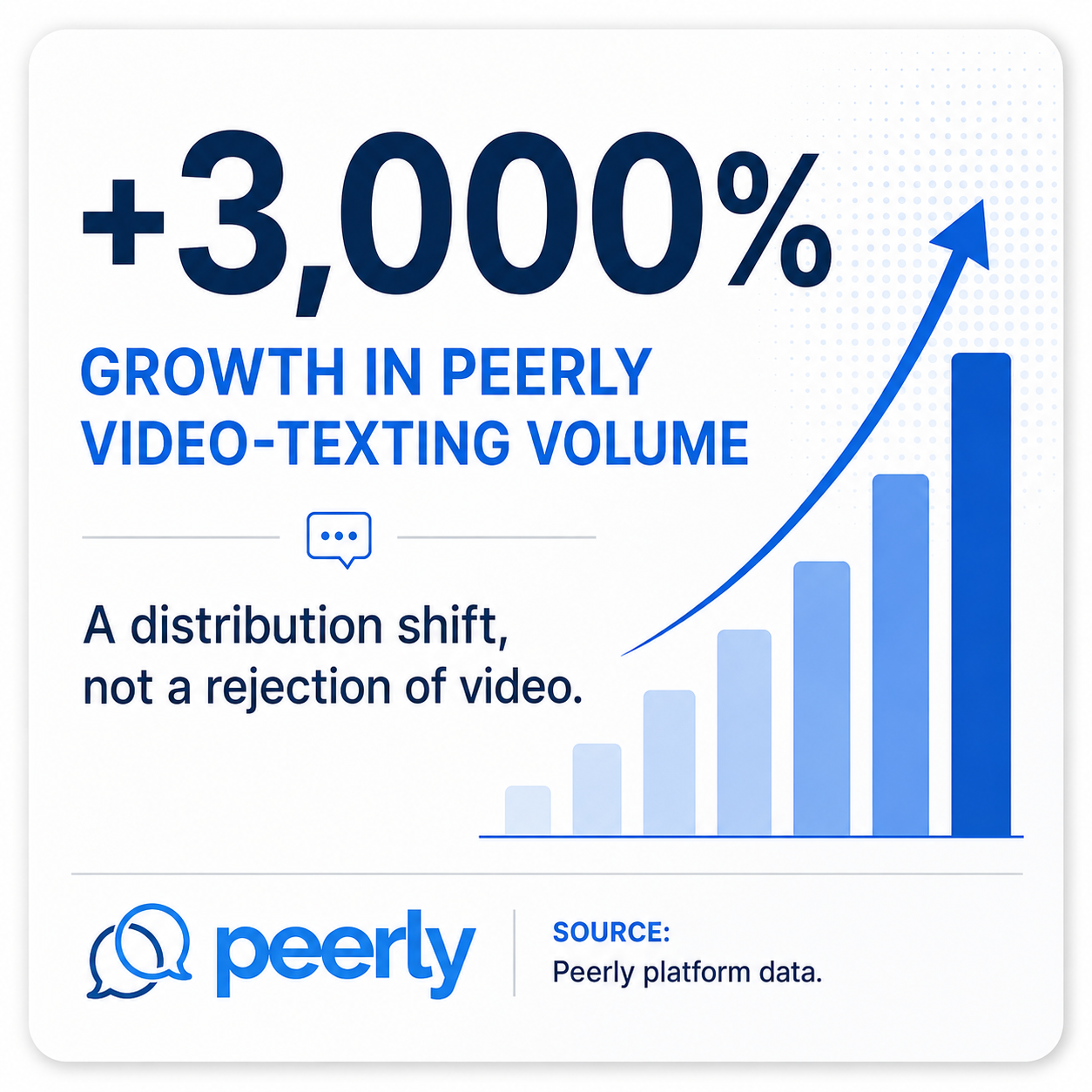
That figure should be read carefully. It is Peerly platform data, not a claim that all political video texting grew 3,000% across the entire market. But that distinction does not make the growth less interesting. It makes the signal more specific: campaigns using the channel dramatically expanded their use of it in a single cycle. They did not abandon social media. They did not abandon television. They began solving a distribution problem by taking a proven creative format and delivering it somewhere the message does not have to compete with an endless feed.
That is what separates a tactic from a channel. A tactic is something a campaign tests. A channel is something it begins budgeting, producing and planning around. When annual volume moves from about 10 million to hundreds of millions, the question stops being whether the format is technically possible. The question becomes where it belongs in the media plan.
The timing is significant. Reuters reported that AdImpact projects a record $11.6 billion in U.S. political advertising for the 2026 election cycle. More money means more commercials, more targeting and more competition for the same finite attention. As that market becomes more crowded, distribution becomes part of the creative strategy itself. A brilliant ad placed in an environment engineered for skipping can still lose before its argument begins.
There are also signs that direct-to-mobile campaigning has moved beyond internal experimentation. Campaigns & Elections named Donald J. Trump for President and Peerly Inc. the 2025 Reed Award winner for Best Use of SMS on a Campaign. Awards are not performance data, but they are evidence of normalization. What was once treated as a niche messaging tactic is increasingly being evaluated alongside established campaign media.
None of this means social media, connected television, streaming or broadcast television suddenly stop working. They do different jobs. Social remains exceptional for discovery, repetition and public conversation. Television still creates mass awareness. Streaming offers targeted reach at scale. Direct video adds something different: the ability to take high-quality creative and place it directly in front of a defined mobile audience without asking a feed algorithm to decide whether the selected voter receives the impression.
A campaign can run a closing argument on television, reinforce it on social, then send that same argument directly to the persuadable voters most likely to decide the race. A statewide spot can become a county-specific contact. A fundraising video can go to past donors. A turnout message can go to identified supporters. The creative does not need to be reinvented for every channel. The delivery becomes more deliberate.
The larger story is easy to miss because it is hiding inside familiar technology. Video already won the mobile screen. The data shows that clearly. The advertising problem is that the feed won the battle for distraction at the same time.
75% Seventy-five percent of mobile traffic tells us where attention wants to go. Ninety-three percent ad avoidance tells us what audiences are trying to escape. More than 3,000% growth in Peerly video texting shows how some campaigns are responding.
The answer is not to make less video. It is to stop assuming that the feed is the only place video belongs.
Keep the motion. Keep the emotion. Keep the speed and visual impact that made short-form video dominant. But choose the audience first, deliver the commercial directly to the device, add context and proof, and give the recipient a way to respond.
The social feed proved that video belongs on the mobile screen. The next battle is over who controls the delivery.
Try a quick free test of Video In-Motion right now. Enter your phone number and get a Video text in 4k clarity.